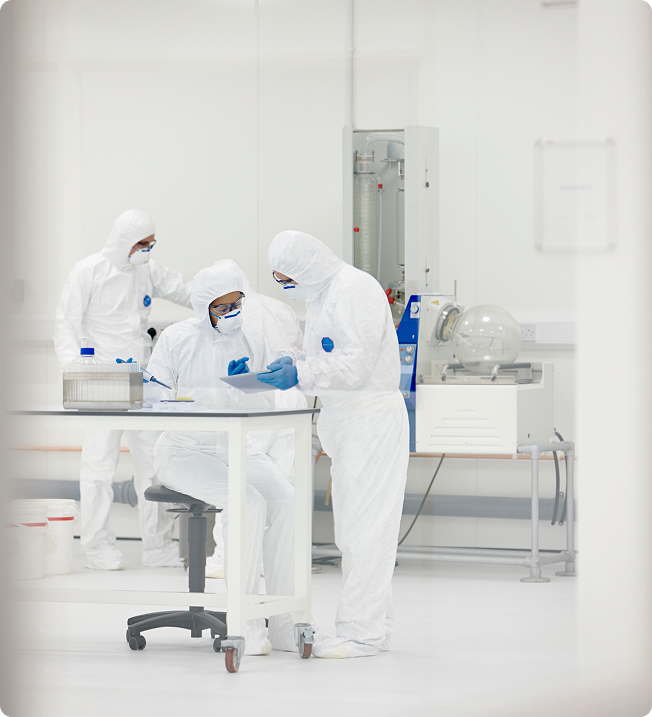
Whether you’re commissioning a new cleanroom, replacing HEPA filters or preparing for an audit, Vivid Air verifies that your controlled environment performs exactly as intended.
Cleanroom testing & validation support
HEPA & filter integrity testing
Cabinet & controlled airflow checks
South African clean air specialists
Every facility needs confidence that its controlled environment performs as expected. Whether you’re commissioning, preparing for an audit or carrying out routine verification, Vivid Air helps you determine the right testing requirements from the start.
Checks measurable performance — particles, airflow, pressure relationships or HEPA filter condition.
Looks at whether the environment performs against the intended requirement, process risk or applicable standard.
We clarify whether you need classification testing, validation reporting, HEPA results or supporting documentation.
Use this as a starting point. The final test scope should be confirmed against the room, equipment, internal requirement and risk level.
1
2
Replaced or installed HEPA filters — look at DOP testing and HEPA integrity testing.
3
4
5
6
The type of validation required depends on the equipment being tested and how it’s used. These are the clean air systems and controlled environments Vivid Air supports.
Performance verified through particle counts, pressure checks and environmental review.
Filter integrity testing, DOP testing and HEPA leak testing on installed filters and housings.
Fume cupboard validation and airflow testing after installation, servicing or concerns.
Clean airflow verified through laminar flow validation and airflow velocity testing.
Airflow performance, pressure relationships and pass box validation for transfer systems.
HEPA performance, airflow delivery and installation integrity in air supply systems.
Airflow verified in extraction hoods, clean air zones and other controlled ventilation.
Validation should be matched to the system, not forced into a generic checklist. These factors help determine which tests are required and how the scope should be defined.
A cleanroom, HEPA housing, fume cupboard, biosafety cabinet and pass box don’t need the same test sequence.
Commissioning, maintenance, filter replacement, audit prep and contamination concerns each create different priorities.
Some environments reference ISO 14644-1, ISO 14644-3 or internal quality specifications.
A failed HEPA seal, unstable pressure or poor particle result can affect product quality, safety or audit readiness.
The report should match your purpose — quality control, maintenance records, compliance or corrective action.
Good validation doesn’t stop at a failed result — it gives a practical route to correction, stabilisation and retesting.
Planning maintenance, commissioning or audit preparation? We confirm when validation is needed and which tests are appropriate for your system.
| Situation | Why testing may be needed | Likely testing direction |
|---|---|---|
| Before using a new cleanroom | Confirms the room performs before production or laboratory work begins. | Cleanroom testing, validation, particle count. |
| After HEPA filter replacement | Checks for leaks, seal issues or installation problems. | DOP testing, HEPA integrity testing, filter integrity testing. |
| After maintenance or repair | Confirms the system has returned to a suitable operating state. | Airflow checks, pressure differential testing, retesting. |
| Before an audit or internal review | Provides current records for quality and compliance teams. | Certification support, validation documentation. |
| After contamination concerns | Helps identify whether particles, airflow or filter performance may be contributing. | Particle count testing, HEPA checks, airflow review. |
| After airflow or pressure problems | Confirms whether the pressure cascade or airflow pattern is stable. | Pressure differential testing, airflow velocity testing. |
| After layout or process changes | Checks whether room use, equipment or movement have affected performance. | Air change verification, particle testing, smoke checks. |
| For controlled equipment | Confirms cabinets, pass boxes or flow benches are performing as expected. | Fume cupboard, biosafety cabinet, pass box, laminar flow validation. |

A successful validation starts long before testing begins. Avoiding these common oversights ensures accurate results, reduces unnecessary retesting and gives you greater confidence in your clean air system.
Particle count, HEPA integrity and pressure differential testing each assess different things. The right combination is the first step to meaningful results.
After installation, cleaning or filter replacement, the environment needs time to settle. Testing too early produces results that don’t reflect normal conditions.
Validation is a snapshot at a point in time. Changes to equipment, processes or room conditions may require repeat testing to maintain confidence.
Validation should do more than satisfy an audit. It should give practical insight into how your environment performs and where reliability can improve.
Upgrades, filter replacements and process changes should be reflected in your records. Current documentation makes future testing more efficient.
A failed result doesn’t necessarily indicate a major system failure — it highlights that further investigation is needed before the environment can be confirmed. Common causes include airflow, filter installation, pressure relationships or testing before the environment has stabilised. The practical fallback process looks like this:
1
Identify the failed area or test point.
2
Review likely causes — HEPA leaks, poor seals, unstable pressure or blocked airflow.
3
Recommend corrective action.
4
Allow the system to stabilise where required.
5
Retest the affected area.
6
Update the documentation once results are confirmed.
Validation isn’t just about pass or fail. It should give your team a clear record of what was tested, what was found and whether any follow-up is needed. Depending on scope, your validation may include:
Professional validation goes beyond collecting results. It means understanding how cleanrooms, filtration and controlled environments work together to find the root cause of performance issues.
Every programme is tailored to the equipment, environment and operational requirements — the right tests for the right reasons.
Where issues are found, we don’t just report results — we help you understand the cause and the most appropriate corrective action.
From cleanrooms and HEPA filtration to biosafety cabinets, fume cupboards and laminar flow benches.
Our South African team helps you plan validation, interpret results and determine the next steps.
Supporting procurement requirements for SA organisations.
Supporting workplace compliance and operational credibility.
Recognised customs and trade compliance credential.
Quality management for consistent processes and delivery.
Clean air and validation pathways